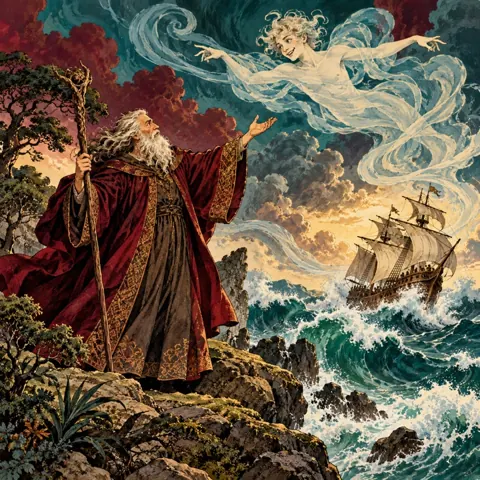
A ship is in trouble, and a boatswain has little patience for the rank of his passengers. Start with the urgency of the storm; the island and its competing claims to authority will emerge as you read.
No account needed for the book or prepared annotations.
Illustration from this reading edition · AI-generated artwork
Complete play · five acts and epilogue
291 prepared notes · coverage is selective
About The Tempest
The Tempest begins with people struggling to survive a storm. In the next scene, Prospero and Miranda look back over how they came to live on the island. These two kinds of opening—urgent action and a remembered history—give you a useful foothold in the play.
Ariel’s songs, Prospero’s commands and Caliban’s language reward close attention. A note can explain a nautical term or an unfamiliar sense of a word without settling the larger questions about authority and freedom. The short explanations below offer another route into individual speeches.
Introduction written with AI assistance; read alongside the primary text.
A way into the book
Read the opening as action: who needs to do what to keep the ship afloat?
Notice when commands come from practical knowledge and when they come from social rank.
Try a speech aloud before deciding that its language is difficult.
Prepared notes include labelled AI-generated or AI-adapted material. They are reading aids, not a claim to a definitive scholarly edition. Explore coverage and editorial sources.
Annotations you can try
Three real notes from this edition. Each links to its passage and retains its source and review information.
Boatswain!
Plain meaning
The boatswain (pronounced “bosun”) supervises the sailors and the ship’s equipment.
AI-adapted source note
Rewritten with AI assistance from the identified commentary. The wording shown is not a quotation from that source.
Source, licence and review status
Selected explanations shortened and rewritten with AI assistance; images and third-party quotations omitted.
Gonzalo jokes that the boatswain looks destined to be hanged, so he cannot be destined to drown. His supposed criminal future becomes a reason to hope they will survive.
AI-adapted source note
Rewritten with AI assistance from the identified commentary. The wording shown is not a quotation from that source.
Source, licence and review status
Selected explanations shortened and rewritten with AI assistance; images and third-party quotations omitted.
Understand Ariel’s song: fathoms, coral, pearls, sea-change and the funeral bell, with the original lines and an explanation of their context.
Keep your place. Ask a question.
A free account saves bookmarks and progress across devices and includes five AI explanations each UTC calendar month. Select a passage to ask a question. AI answers can be mistaken; check the text and source notes.
Account creation uses ChatGPT sign-in. No payment details are needed for the free beta.