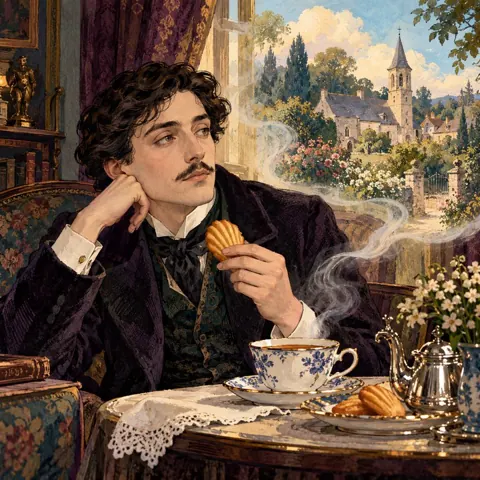
The narrator begins between sleep and waking, unsure for a moment of his room and even of himself. Give the long sentences time. Their changes of direction are part of the experience of remembering.
No account needed for the book or prepared annotations.
Illustration from this reading edition · AI-generated artwork
Complete Swann’s Way · In Search of Lost Time, volume 1 · C. K. Scott Moncrieff’s 1922 translation
268 prepared notes · coverage is selective
About Swann’s Way
Swann’s Way begins with the narrator waking and trying to place himself. Rooms, stories and childhood memories overlap. Rather than moving immediately through a sequence of events, the writing follows the associations by which an experience returns to consciousness.
This is the first complete volume of In Search of Lost Time, in C. K. Scott Moncrieff’s 1922 English translation. Notes can help with a cultural reference or an unfamiliar object; the sentence itself often supplies the emotional context. When a long passage becomes difficult, identify the sensation or remembered place around which it turns.
Introduction written with AI assistance; read alongside the primary text.
A way into the book
Notice when a sentence moves from the present room into a remembered one.
Pause at a full stop and ask what sensation or association has changed.
Read this as one complete volume, not the whole of In Search of Lost Time.
The text you are reading
Complete Swann’s Way · In Search of Lost Time, volume 1 · C. K. Scott Moncrieff’s 1922 translation. View the text source.
Prepared notes include labelled AI-generated or AI-adapted material. They are reading aids, not a claim to a definitive scholarly edition. Explore coverage and editorial sources.
Annotations you can try
Three real notes from this edition. Each links to its passage and retains its source and review information.
For a long time
Plain meaning
The opening moves between the adult narrator’s present and remembered nights. A change in time or room can happen inside a single paragraph; these shifts are part of the narration, rather than a continuous account of one evening.
AI-generated reading note
Prepared with AI assistance for Not Dead Yet Classics. This is newly written commentary, not wording by the author of the book or a quotation from the linked references.
Source, licence and review status
Original explanation or possible interpretation written for this edition. References provide context; a link alone does not verify every claim.
The lantern projects images onto the bedroom walls. In this passage, the moving pictures overlay the familiar room with a story, temporarily making its ordinary objects feel strange.
AI-generated reading note
Prepared with AI assistance for Not Dead Yet Classics. This is newly written commentary, not wording by the author of the book or a quotation from the linked references.
Source, licence and review status
Original explanation or possible interpretation written for this edition. References provide context; a link alone does not verify every claim.
Combray is the town of the narrator’s childhood visits. Here it is a place reconstructed through memory: rooms, people, routines and walks gradually give it shape.
AI-generated reading note
Prepared with AI assistance for Not Dead Yet Classics. This is newly written commentary, not wording by the author of the book or a quotation from the linked references.
Source, licence and review status
Original explanation or possible interpretation written for this edition. References provide context; a link alone does not verify every claim.
A free account saves bookmarks and progress across devices and includes five AI explanations each UTC calendar month. Select a passage to ask a question. AI answers can be mistaken; check the text and source notes.
Account creation uses ChatGPT sign-in. No payment details are needed for the free beta.