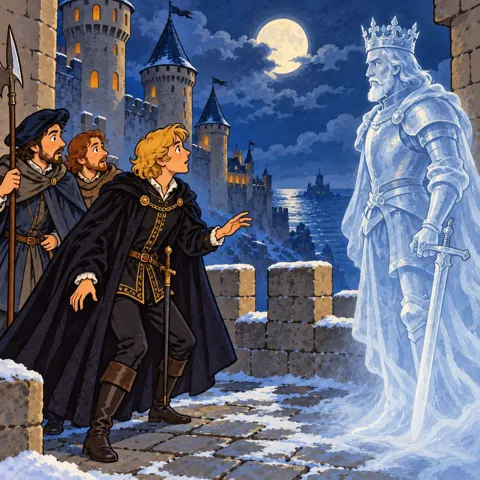
A question in the dark. A kingdom unsure of itself.
The first voice demands to know who is there. Before the prince appears, a watch on the battlements introduces a world of apprehension and uncertain recognition. Follow the questions as closely as the answers.
No account needed for the book or prepared annotations.
Illustration from this reading edition · AI-generated artwork
Complete play · five acts
527 prepared notes · coverage is selective
About Hamlet
Hamlet opens on a night watch at Elsinore. Questions about identity, evidence and trust appear before Hamlet himself enters. Reading the short exchanges between the guards slowly establishes the atmosphere without needing a full account of the plot.
The prepared notes explain wordplay, older meanings and cultural references. Keep a distinction between an event on stage and a character’s account of it: people in this play observe, report, perform and withhold. You can read all five acts here, returning to a speech when its words acquire a different significance.
Introduction written with AI assistance; read alongside the primary text.
A way into the book
Keep the speakers separate in the opening watch scene.
Notice the difference between what a character sees and what they conclude.
Use the notes for unfamiliar language while leaving room for competing interpretations.
Prepared notes include labelled AI-generated or AI-adapted material. They are reading aids, not a claim to a definitive scholarly edition. Explore coverage and editorial sources.
Annotations you can try
Three real notes from this edition. Each links to its passage and retains its source and review information.
Who’s there
Plain meaning
The play opens with a demand for identification. The watchmen's uncertainty immediately makes recognition and trust important.
AI-generated reading note
Prepared with AI assistance for Not Dead Yet Classics. This is newly written commentary, not wording by the author of the book or a quotation from the linked references.
Source, licence and review status
Original explanation or possible interpretation written for this edition. References provide context; a link alone does not verify every claim.
Hamlet twists the language of family connection: Claudius is now both his uncle and his stepfather.
AI-generated reading note
Prepared with AI assistance for Not Dead Yet Classics. This is newly written commentary, not wording by the author of the book or a quotation from the linked references.
Source, licence and review status
Original explanation or possible interpretation written for this edition. References provide context; a link alone does not verify every claim.
Hamlet distinguishes visible signs of mourning from the grief he claims to feel inwardly.
AI-generated reading note
Prepared with AI assistance for Not Dead Yet Classics. This is newly written commentary, not wording by the author of the book or a quotation from the linked references.
Source, licence and review status
Original explanation or possible interpretation written for this edition. References provide context; a link alone does not verify every claim.
A free account saves bookmarks and progress across devices and includes five AI explanations each UTC calendar month. Select a passage to ask a question. AI answers can be mistaken; check the text and source notes.
Account creation uses ChatGPT sign-in. No payment details are needed for the free beta.