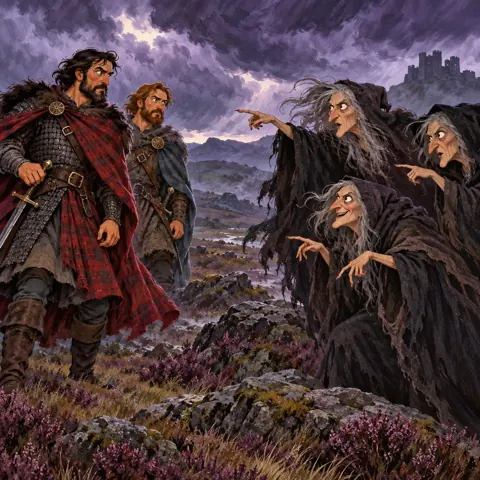
Thunder, a meeting and a riddle open the play. The language binds opposites together before the action gives those words their full weight. Listen to its rhythms, then follow how characters respond to what they hear.
No account needed for the book or prepared annotations.
Illustration from this reading edition · AI-generated artwork
Complete play · five acts
310 prepared notes · coverage is selective
About Macbeth
Macbeth opens with the witches’ brief meeting, followed by a report of battle and an encounter on the heath. Those different kinds of speech matter: a soldier reports what has happened, the witches predict, and Macbeth begins to imagine possibilities.
The play’s language often compresses a difficult thought into a short phrase. The annotations and linked explanations unpack these phrases while leaving interpretive questions open. Start with the introductory guide for Act I, or use the dagger explanation when you reach Act II; that page discusses the situation at that point in the play.
Introduction written with AI assistance; read alongside the primary text.
A way into the book
Begin with the short first scene and its paired opposites.
Distinguish a report, a prediction and a decision.
Keep track of titles and forms of address with the prepared notes.
Prepared notes include labelled AI-generated or AI-adapted material. They are reading aids, not a claim to a definitive scholarly edition. Explore coverage and editorial sources.
Annotations you can try
Three real notes from this edition. Each links to its passage and retains its source and review information.
Fair is foul
Plain meaning
The witches join opposites in a compact verbal puzzle. The language prepares us for appearances that cannot be trusted.
AI-generated reading note
Prepared with AI assistance for Not Dead Yet Classics. This is newly written commentary, not wording by the author of the book or a quotation from the linked references.
Source, licence and review status
Original explanation or possible interpretation written for this edition. References provide context; a link alone does not verify every claim.
A Scottish noble title in the play. Macbeth holds the title of Glamis and is offered that of Cawdor.
AI-generated reading note
Prepared with AI assistance for Not Dead Yet Classics. This is newly written commentary, not wording by the author of the book or a quotation from the linked references.
Source, licence and review status
Original explanation or possible interpretation written for this edition. References provide context; a link alone does not verify every claim.
The three prophetic women. Their words introduce the question of how a prediction can shape the actions of its hearer.
AI-generated reading note
Prepared with AI assistance for Not Dead Yet Classics. This is newly written commentary, not wording by the author of the book or a quotation from the linked references.
Source, licence and review status
Original explanation or possible interpretation written for this edition. References provide context; a link alone does not verify every claim.
What does “fair is foul and foul is fair” mean? Explore the witches’ paradox, “fog and filthy air”, and Macbeth’s echo, with the original scene free to read.
Read Macbeth’s dagger speech in plain English: sight and touch, “sensible”, “palpable”, “dudgeon” and the question of the vision’s source.
Keep your place. Ask a question.
A free account saves bookmarks and progress across devices and includes five AI explanations each UTC calendar month. Select a passage to ask a question. AI answers can be mistaken; check the text and source notes.
Account creation uses ChatGPT sign-in. No payment details are needed for the free beta.